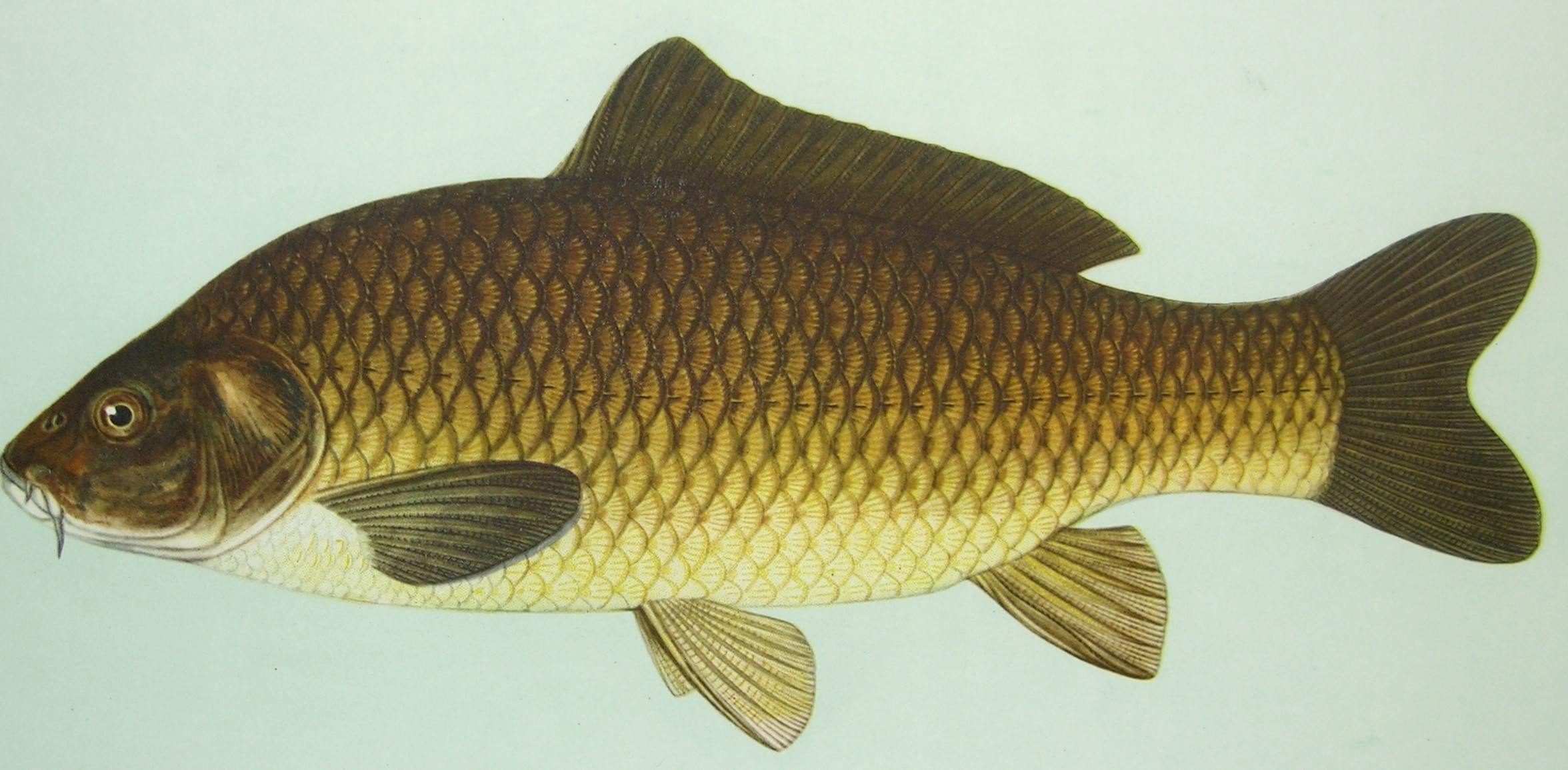
Common carp (Cyprinus carpio) belongs to the order Cypriniformes and the family Cyprinidae, which is considered the largest family of freshwater fish.
C. carpio grows rapidly, achieves sexual maturation in the second year of life, and is highly fertile (about 2 million eggs per female). Common carp dominate wetlands and lakes because of their long life spans and large size. They are the largest of the Cyprinidae family and can weigh well over 9 kg and span more than 60 cm
It generally inhabits freshwater environments, especially ponds, lakes and rivers, and also rarely inhabits brackish-water environments. It is naturally distributed in its wild form from the piedmont zone of the Danube Rover to the Black, Caspian and Aral Sea basins, as western dispersant in central Asia and as eastern dispersant in Siberia.
Now, it is widely distributed in almost all countries of the world but is very popular in Asia and some European countries.
The fish can tolerate a wide range of water quality parameters. In natural water bodies, this species can survive in very low water temperature and it can tolerate low concentrations and supersaturation of dissolved oxygen.
Common carp is frequently called an ‘ecological engineer’ because it can modify ecological characteristics of aquatic systems.
Habitat of common carp
The term "fish" is used to classify a particular type of food, similar to the way meat, poultry, and cheese are categorized. The variety of fish species exceeds that of other food groups, with the United States alone incorporating at least 50 different types of fish and shellfish for human consumption.
Showing posts with label habitat. Show all posts
Tuesday, September 21, 2021
Saturday, August 8, 2020
Crawfish
Crawfish are small, freshwater crustaceans that can be found in many parts of the world, including North and South America, Australia, and Europe. Like all arthropods freshwater crawfish have a multi-layered exoskeleton hardened by calcium salts except around the joints where the integument is soft and flexible.
The body consists of 20 segments, which are divided into three regions: head with the eyes, sensory appendages, mandible and maxillae; thorax with maxillipeds and five pairs of leg-like appendages; and abdomen equipped with pleopods used for swimming and egg-carrying in females.
Freshwater crawfish are found in a wide range of freshwater habitats, from sea level to sub-alpine regions, including lakes, dams, irrigation canals and streams. Freshwater crawfish is found in lentic and lotic freshwater habitats: sluggish streams and lentic habitats, swamps, ditches, sloughs and ponds, etc., especially in vegetation, leaf litter, etc. It avoids streams and ditches with a strong flow, where it is replaced by other species. Freshwater crawfish can be found in most substrate types although deep soft sediment, particularly if it is anoxic (black color and often associated with a sulphur smell), does not hold the same densities of freshwater crawfish as other substrate types.
It exhibits territorial behavior and is aggressive with its own species. It burrows during periods of drought or cold. It is benthic and omnivorous, feeding on insects, larvae, detritus, etc., with a preference for animal matter.
Crawfish are an excellent source of high-quality protein and are low in calories, fat and saturated fat. They also are a good source of vitamin B12, niacin, iron, copper and selenium.
Crawfish
The body consists of 20 segments, which are divided into three regions: head with the eyes, sensory appendages, mandible and maxillae; thorax with maxillipeds and five pairs of leg-like appendages; and abdomen equipped with pleopods used for swimming and egg-carrying in females.
Freshwater crawfish are found in a wide range of freshwater habitats, from sea level to sub-alpine regions, including lakes, dams, irrigation canals and streams. Freshwater crawfish is found in lentic and lotic freshwater habitats: sluggish streams and lentic habitats, swamps, ditches, sloughs and ponds, etc., especially in vegetation, leaf litter, etc. It avoids streams and ditches with a strong flow, where it is replaced by other species. Freshwater crawfish can be found in most substrate types although deep soft sediment, particularly if it is anoxic (black color and often associated with a sulphur smell), does not hold the same densities of freshwater crawfish as other substrate types.
It exhibits territorial behavior and is aggressive with its own species. It burrows during periods of drought or cold. It is benthic and omnivorous, feeding on insects, larvae, detritus, etc., with a preference for animal matter.
Crawfish are an excellent source of high-quality protein and are low in calories, fat and saturated fat. They also are a good source of vitamin B12, niacin, iron, copper and selenium.
Crawfish
Tuesday, March 7, 2017
Shellfish species of surf clams
The surf clam or ‘skimmer’ is large, reaching a length of 8 in, (20.3 cm). It is found just below the surface of sandy bottoms in waters 30 to 100 ft (9 to 30 m) deep off Atlantic Coast states from Massachusetts to including Virginia.
Areas of coarse grain size (i.e pebbles or cobbles) are virtually devoid of surf clams. Atlantic surf clams are planktivorous filter feeders that pump water through their siphons over the gills to trap foods.
Many predators, including snails, shrimps, crabs, and fish –haddock and cod, feed on surf clams.
Maximum age exceeds 30 years; surf clams of age 15-20 years are common in many areas. Surf clams are harvested when they reach 4 inch (10 cm) which occurs at about 5 years of age.
Currently, commercial concentrations are primarily found off of the New Jersey shore, the Delmarva Peninsula, and on Georges Bank.
Most of harvesting this species is done off New Jersey with water-jet dredges having V-shaped scoop. Aboard the boats, the clams are placed in baskets or jute bags and brought to the processing plants without refrigeration.
Shellfish species of surf clams
Areas of coarse grain size (i.e pebbles or cobbles) are virtually devoid of surf clams. Atlantic surf clams are planktivorous filter feeders that pump water through their siphons over the gills to trap foods.
Many predators, including snails, shrimps, crabs, and fish –haddock and cod, feed on surf clams.
Maximum age exceeds 30 years; surf clams of age 15-20 years are common in many areas. Surf clams are harvested when they reach 4 inch (10 cm) which occurs at about 5 years of age.
Currently, commercial concentrations are primarily found off of the New Jersey shore, the Delmarva Peninsula, and on Georges Bank.
Most of harvesting this species is done off New Jersey with water-jet dredges having V-shaped scoop. Aboard the boats, the clams are placed in baskets or jute bags and brought to the processing plants without refrigeration.
Shellfish species of surf clams
Friday, July 1, 2016
Queen parrotfish
The queen parrotfish occurs in the Western Central Atlantic ranging from Bermuda to northern South America and throughout the Caribbean Sea.
The queen parrotfish inhabits coral reefs and adjacent habitats, from 3-25 m depth. The parrot fishes are closely related to the wrasses. It is often observed in groups of one supermale with several young adults, most of which are believed to be females. For identification of the supermale, note the distinct markings on the nose, pectoral fins and tail and the lunate tail.
The main difference is the teeth: parrotfishes have teeth fused into a parrotlike beak that is used to crunch through coral and other hard material.
Maximum reported size us 61 cm TL (male). Size at maturity and age at first maturity are estimated as 30.6 cm TL and 1.1 years, respectively.
The female queen parrotfish is brown with a broad, whitish side stripe. The male is blue-green, with wavy, yellow and green stripes on the head.
Queen parrotfish
The queen parrotfish inhabits coral reefs and adjacent habitats, from 3-25 m depth. The parrot fishes are closely related to the wrasses. It is often observed in groups of one supermale with several young adults, most of which are believed to be females. For identification of the supermale, note the distinct markings on the nose, pectoral fins and tail and the lunate tail.
The main difference is the teeth: parrotfishes have teeth fused into a parrotlike beak that is used to crunch through coral and other hard material.
Maximum reported size us 61 cm TL (male). Size at maturity and age at first maturity are estimated as 30.6 cm TL and 1.1 years, respectively.
The female queen parrotfish is brown with a broad, whitish side stripe. The male is blue-green, with wavy, yellow and green stripes on the head.
Queen parrotfish
Labels:
habitat,
queen parrotfish,
size
Wednesday, February 11, 2015
Macrobrachium rosenbergii
Macrobrachium rosenbergii is the largest species of the genus the male can reach a total length (from tip of rostrum to tip of telson) of 320 mm, the females of 250 mm. It is the largest natantian prawn in the world and belongs to the family Palaemonidae.
The body is usually of a greenish to brownish grey, sometimes more bluish color and is darker in larger specimens.
Macrobrachium rosenbergii are found most inland freshwater areas including lakes, rivers, swamps, irrigation ditches, canals and ponds, swell as in estuarine areas. It is indigenous to south and south-east Asia, northern Oceania, northern Australia and the islands of the western Pacific.
It is a traditional food source throughout this range and now supports a significant aquaculture industry over most of its natural distribution.
It has become the main freshwater prawn species for small-scale and large-scale farming because of its growth, large size, better meat quality, omnivorous feeding habit and established domestic and export markets in Asia.
Macrobrachium rosenbergii live in tropical freshwater environments that are influenced by adjacent brackish areas, due to the fact that its larval development must take place in brackishwater.
Some species of Macrobrachium prefer clearwater rivers while others, including M.
Rosenbergii are often found in extremely turbid conditions.
Macrobrachium rosenbergii
The body is usually of a greenish to brownish grey, sometimes more bluish color and is darker in larger specimens.
Macrobrachium rosenbergii are found most inland freshwater areas including lakes, rivers, swamps, irrigation ditches, canals and ponds, swell as in estuarine areas. It is indigenous to south and south-east Asia, northern Oceania, northern Australia and the islands of the western Pacific.
It is a traditional food source throughout this range and now supports a significant aquaculture industry over most of its natural distribution.
It has become the main freshwater prawn species for small-scale and large-scale farming because of its growth, large size, better meat quality, omnivorous feeding habit and established domestic and export markets in Asia.
Macrobrachium rosenbergii live in tropical freshwater environments that are influenced by adjacent brackish areas, due to the fact that its larval development must take place in brackishwater.
Some species of Macrobrachium prefer clearwater rivers while others, including M.
Rosenbergii are often found in extremely turbid conditions.
Macrobrachium rosenbergii
Sunday, March 11, 2012
Habitats of fish
Important habitats can be defined as those that support a significant percentage of the population at comparatively high density. The waters and substrate necessary to fish for spawning, breeding, feeding or growth to maturity.
Fishes live in virtually every water habitat found on earth. There are fish in mountain lakes above 4000 meters and fish in the deep ocean, at depth of at least 8300 meters.
The world’s deepest living fish Abyssobrotula galatheae was found in the Puerto Rican Trench at a depth of 8372 meters while Tibetan stoneloach Triplophysa stoliczkai lives at altitudes over 5200 meters in the Himalayas.
In the outflows of hot springs fish can be found living at temperatures of around 42 ° C whereas in the Antarctic, fish can be found resting on chunks of ice surrounded by water that is within a fraction of a degree of freezing solid.
The salinities of the water in which fish are known to live range from the purest water of granitic mountain basins to water over four times saltier than sea water.
Poor fisheries management is one of the biggest threats to marine biodiversity and benthic habitats.
Agricultural practices that alter water flow or increase water runoff from agricultural land would affect the quantity and quality of pond, lake and stream habitats for fish.
Agricultural practices that increase soil erosion greatly aquatic habitats by increasing the siltation and by carrying off nutrients that increase eutrophication.
Fishes live in virtually every water habitat found on earth. There are fish in mountain lakes above 4000 meters and fish in the deep ocean, at depth of at least 8300 meters.
The world’s deepest living fish Abyssobrotula galatheae was found in the Puerto Rican Trench at a depth of 8372 meters while Tibetan stoneloach Triplophysa stoliczkai lives at altitudes over 5200 meters in the Himalayas.
In the outflows of hot springs fish can be found living at temperatures of around 42 ° C whereas in the Antarctic, fish can be found resting on chunks of ice surrounded by water that is within a fraction of a degree of freezing solid.
The salinities of the water in which fish are known to live range from the purest water of granitic mountain basins to water over four times saltier than sea water.
Poor fisheries management is one of the biggest threats to marine biodiversity and benthic habitats.
Agricultural practices that alter water flow or increase water runoff from agricultural land would affect the quantity and quality of pond, lake and stream habitats for fish.
Agricultural practices that increase soil erosion greatly aquatic habitats by increasing the siltation and by carrying off nutrients that increase eutrophication.
Habitats of fish
Subscribe to:
Posts (Atom)
Popular Posts
-
Norwegian fjord trout, celebrated for its pure and fresh flavor, has earned a reputation as a culinary delight. This fish is distinguished b...
-
Scomberomorus, an ancient name for mackerel fish. The full name is Scomberomorus commerson. The name mackerel given by the French, German an...
-
Otter Trawls Otter trawls are used to catch cod, haddock, flounder, and other bottom fish. The otter trawl is large, cone-shaped net t...
-
Fish Farming of the Sea The global appetite for fish has doubles over the last thirty years. But because of depletion of the world stock, vi...
-
Brachyuran crab is a true crab belonging to the infraorder Brachyura. Brachyuran crabs are the most diverse group among marine fauna in the ...


