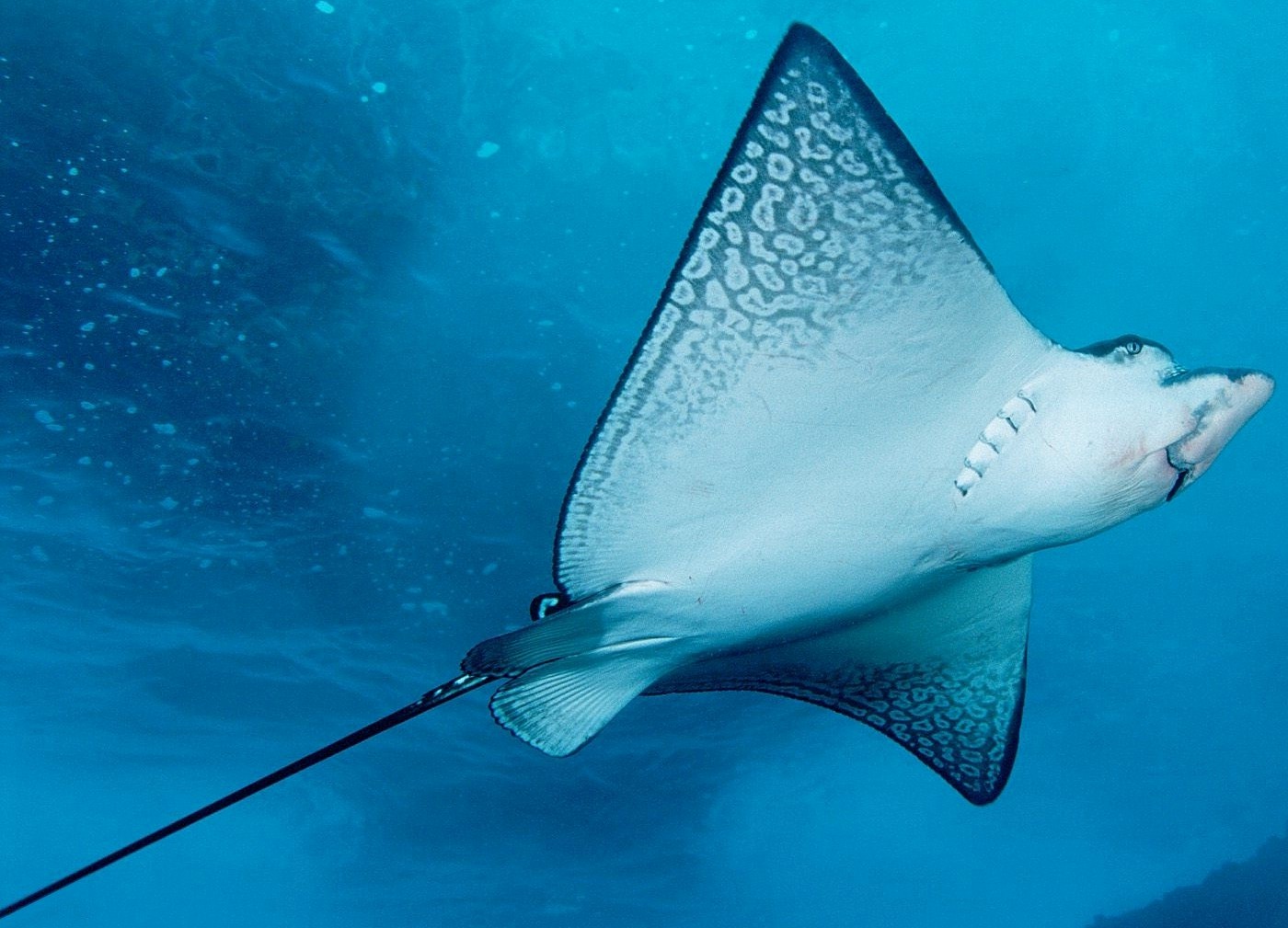
Rays are sharks’ cousins, but unlike their relatives, they are flat, and live mostly on the seabed, in shallow, warm water. The manta ray is the monster on the family.
The Atlantic manta ray, Manta birostris, is found in temperate oceans on the coast of Africa, in the Atlantic from North Carolina to Brazil, and on the Pacific coast from California to northern Peru.
Manta ray is also known as Devil ray, devil fish, Flying devil fish, Ox ray, Diamond fish, Eregoodoo, and Munguna. The largest recorded manta ray measured over twenty-seven feet (9.1) meters. Like sharks, these creatures have skeletons made form flexible cartilage instead of bone.
The manta’s body is almost flat, with large pectoral fins extending like wings on each side. It feeds like a basking shark, swimming with its mouth open so food-rich water flows through its gills.
Manta rays
The term "fish" is used to classify a particular type of food, similar to the way meat, poultry, and cheese are categorized. The variety of fish species exceeds that of other food groups, with the United States alone incorporating at least 50 different types of fish and shellfish for human consumption.
Showing posts with label rays. Show all posts
Monday, August 7, 2017
Tuesday, July 4, 2017
Rays: superorder of cartilaginous fish
Living fishes are comprised of two primary taxonomic groups. Rays, along with sharks and chimaeras (elephant fish, ghost sharks, rabbitfishes and spookfishes), collectively known as the ‘cartilaginous fishes’, form one of these two major groups of modern fishes, the class Chodrichthyes having skeletons built of cartilage with superficial calcification rather than bone).
Rays are found in all oceans of the world. They are the largest subgroup of the chondrichthyan fishes and presently comprise 26 families and 633 valid named species.
These can divided into several groups: skates, electric rays, sawfish and stingrays. Rays vary in size. The little or hedgehog, skate is less than 20 inches (5 centimeters) long. The Atlantic manta, or giant devil ray, has wingspan of up to 23 feet (7 meters).
Although rays lack the bony scales of the placoderms and osteotracans, their skin is cored with small toothlike scales that give it the feel of sandpaper.
Rays: superorder of cartilaginous fish
Rays are found in all oceans of the world. They are the largest subgroup of the chondrichthyan fishes and presently comprise 26 families and 633 valid named species.
These can divided into several groups: skates, electric rays, sawfish and stingrays. Rays vary in size. The little or hedgehog, skate is less than 20 inches (5 centimeters) long. The Atlantic manta, or giant devil ray, has wingspan of up to 23 feet (7 meters).
Although rays lack the bony scales of the placoderms and osteotracans, their skin is cored with small toothlike scales that give it the feel of sandpaper.
Rays: superorder of cartilaginous fish
Labels:
cartilaginous fish,
rays,
shark
Subscribe to:
Posts (Atom)
Popular Posts
-
The dorab wolf-herring is a fish species from the genus Chirocentrus of the family Chirocentridae. The dorab wolf-herring occurs inshore, in...
-
Scomberomorus, an ancient name for mackerel fish. The full name is Scomberomorus commerson. The name mackerel given by the French, German an...
-
Norwegian fjord trout, celebrated for its pure and fresh flavor, has earned a reputation as a culinary delight. This fish is distinguished b...
-
Fish Farming of the Sea The global appetite for fish has doubles over the last thirty years. But because of depletion of the world stock, vi...
-
Otter Trawls Otter trawls are used to catch cod, haddock, flounder, and other bottom fish. The otter trawl is large, cone-shaped net t...