The fish gill is arguably the most physiologically diversified and anatomically complex vertebrate organ. Gills are the equivalent of a mammal’s lungs. Their primary purpose is to exchange gases, take oxygen in and release carbon dioxide out of the fish.
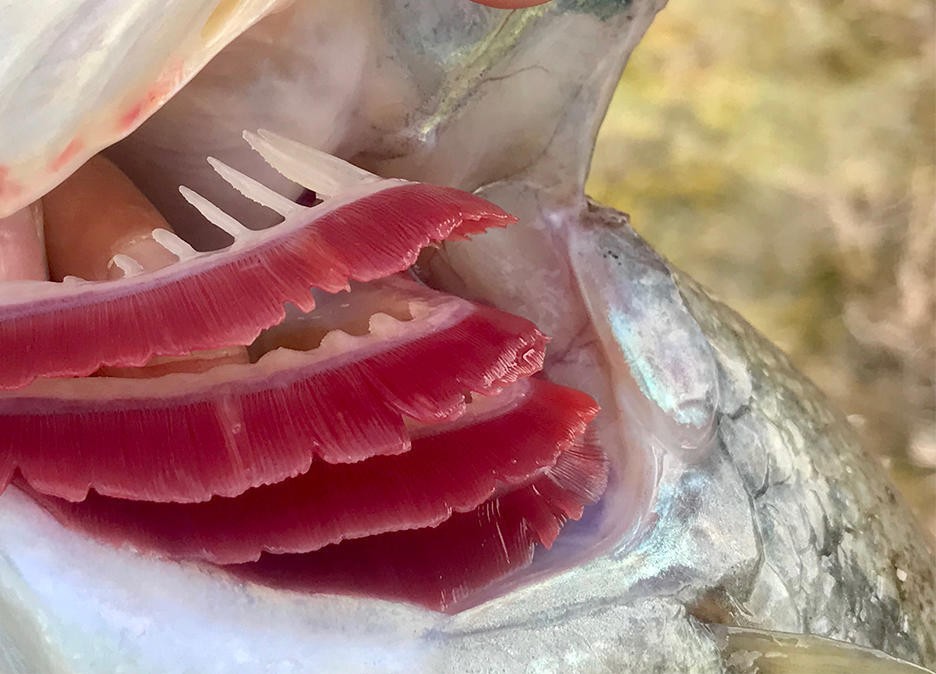
Bony fish have eight gill arches, four on each side of the mouth cavity. Each arch bears numerous paired filaments and many thin respiratory lamellae, thereby greatly increasing the respiratory surface area. The gills are protected by a gill cover in teleosts and many other fishes but by flaps of skin in sharks, rays, and some of the older fossil fish groups.
Fish gills are responsible for a number of critical functions in addition to respiration: gas exchange, plays dominant roles in osmotic and ionic regulation, excretion of nitrogenous waste, pH regulation, and hormone production.
Fish need to take in oxygen and expel carbon dioxide in order to survive. Most fishes exchange dissolved oxygen and carbon dioxide in water by means of the gills.
Gills are branching organs located on the side of fish heads that have many, many small blood vessels called capillaries.
Blood capillaries is beneath a thin epithelium that separates the blood from the water, allowing oxygen and carbon dioxide to pass through easily.
As the fish opens its mouth, water runs over the gills, and blood in the capillaries picks up oxygen that’s dissolved in the water. Then the blood moves through the fish’s body to deliver the oxygen, just like in humans.
Functions of fish gills
The term "fish" is used to classify a particular type of food, similar to the way meat, poultry, and cheese are categorized. The variety of fish species exceeds that of other food groups, with the United States alone incorporating at least 50 different types of fish and shellfish for human consumption.
Showing posts with label fish gills. Show all posts
Thursday, April 28, 2022
Subscribe to:
Posts (Atom)
Popular Posts
-
Risks Associated With Seafood The safety of seafood in the US has increased in recent decades, although there are still a number of chemica...
-
Skipjack - leaner than albacore tune; it is the most commonly used tuna for canning. Skipjack tuna are highly migratory and have been fishe...
-
The species commonly referred to as the king crab is not a true crab but shares many structural and behavioral similarities with crabs. Unli...
-
Scomberomorus, an ancient name for mackerel fish. The full name is Scomberomorus commerson. The name mackerel given by the French, German an...
-
Long Lines Fishing Long Lines are used to catch halibut and in some instance, cod and haddock. The long line has a comparatively heavy cen...
